Kitchen exhaust · Configured industrial applications
Trion Air Boss ATS: Kitchen Exhaust and Modular ESP Selection Guide
Compare ATS sizes, electrostatic collection, optional odor-control stages and the installation details needed for a kitchen exhaust application.
Start with the application
Match the system, not just the cabinet.
Review the required airflow, collection objective, selected stages, installation and ongoing service together.
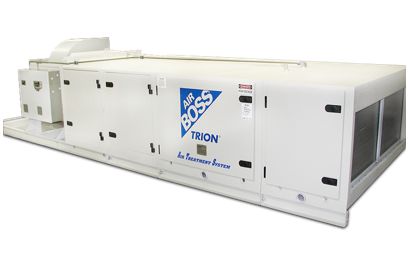
Manufacturer photograph; equipment shown may include optional sections.
Where ATS fits
Air Boss ATS is a modular electrostatic air treatment system for commercial kitchen exhaust and suitable industrial applications. For a kitchen project, begin with the appliance schedule, hood exhaust airflow and proposed discharge, then review the collection and odor-treatment stages.
The same family appearing in both kitchen and industrial literature does not make every configuration interchangeable. Explain the actual process and contaminants so the selected equipment can be reviewed for that duty.
How the modules work together
The ESP section electrically charges particles and collects them on plates. Its integral water-wash arrangement removes collected material during the cleaning sequence. Media filtration and adsorber modules serve separate functions and must be specified in the selected package.
Odor-producing gases are not the same as particles. Identify the odor objective when considering adsorption media. A particle-efficiency figure cannot establish control of every cooking odor.
Choose a size and an operating point
The brochure lists six base sizes: ATS-2, ATS-4, ATS-6, ATS-8, ATS-10 and ATS-12. The comparison below keeps the published 95% and 90% DOP airflow points separate. Higher airflow is not a free capacity increase at unchanged collection performance.
Review the fan duty with all selected sections, prefilters, afterfilters and external duct losses. Hood pickups, transitions and the discharge arrangement are part of the system review. Confirm the current factory selection and outline drawing before committing equipment space.
Plan access, wash utilities and controls
Show which side can be opened for service and allow space to remove cells, filters and odor media. Coordinate the wash-water supply, drainage, detergent system, power and control location with the installation instructions.
Automatic washing does not eliminate maintenance. Trion's maintenance checklist calls for routine detergent and operating-status checks, verification of wash operation, and periodic inspection and manual cleaning. Use the complete manual and project duty to establish the service plan.
Trion modular ESP · model comparison
Compare the six ATS sizes
Models across the top, features down the left. Select a model to highlight its column. ✓ Standard = listed base feature; ✓ Optional = selected additional section, subject to configuration review.
Scroll horizontally to compare every model. Six base cabinet sizes.
| Feature / configuration | ATS-2Highlighted | ATS-4 | ATS-6 | ATS-8 | ATS-10 | ATS-12 |
|---|---|---|---|---|---|---|
| CFM at 95% · 0.3-micron DOP | 1,285 | 2,570 | 4,186 | 5,138 | 6,756 | 8,373 |
| CFM at 90% · 0.3-micron DOP | 1,593 | 3,187 | 5,192 | 6,374 | 8,379 | 10,385 |
| Cell face area · sq. ft. | 2.94 | 5.88 | 9.58 | 11.76 | 15.46 | 19.16 |
| Electrostatic collection | Standard | Standard | Standard | Standard | Standard | Standard |
| Additional media section | Optional | Optional | Optional | Optional | Optional | Optional |
| Odor-control section | Optional | Optional | Optional | Optional | Optional | Optional |
| Wash arrangement | Integral | Integral | Integral | Integral | Integral | Integral |
CFM is tied to the stated DOP particle test point. Do not combine the 95% and 90% columns into a fixed-efficiency range, treat them as odor-removal ratings, or mix them with the brochure’s ASHRAE dust-spot columns. Actual selection includes all filter stages, airflow distribution and total fan static pressure.
The ATS brochure identifies an integral wash system. Coordinate the actual utility and control requirements with the selected assembly. Additional media, odor, fan and fire-protection arrangements require project-specific review.
Source: ATS brochure, model selection p. 7 (PDF). Published reference tables; confirm current equipment with Tillman.
Prepare your project review
- Appliances or process, materials/fuel and operating hours
- Required CFM, collection objective and separate odor concerns
- Hood/pickup layout, duct resistance and proposed discharge
- Available space, service access, support and electrical supply
- Selected wash utilities, controls and fire-protection coordination
- For replacement: complete model/serial number, component labels and photos
Common questions
Does ATS replace the cooking hood?
No. It treats the captured exhaust stream. Hood capture, ducting, fan performance, fire protection and discharge still require coordinated project design.
Can ATS be chosen from CFM alone?
No. Include the collection target, cooking duty, odor concern, filter stages and pressure requirement. Compare CFM at the stated efficiency point.
Does the family name establish approval for sidewall discharge?
No. Review the exact equipment and proposed installation with the project team and applicable authorities.
Manufacturer resources
- ATS product brochure · selection table p. 7 (PDF)
- ATS installation, operation and service manual (PDF)
- Model 75 / ATS maintenance quick checks (PDF)
Literature reviewed November 13, 2026. Verify the current factory selection, options and project submittal before ordering.
Talk with Tillman & Associates
We help engineers, contractors and facility teams across Houston, San Antonio, Austin, Corpus Christi, Beaumont, College Station, Galveston and surrounding South Texas communities.
Send your project details →